
 Florida Plastic Surgery - Dr. Hamwi


Believe it or not, surgery done with the intent of restoring appearance has been taking place since as long as surgery has been performed. If you are considering breast augmentation today, you have more choices, and far safer ones, than at any point in the procedure’s history. Breast implants have been refined for more than six decades, and the devices placed today hardly resemble the first ones developed in the 1960s. Understanding how the options have evolved can help you walk into a consultation feeling informed and confident rather than overwhelmed.
In this blog, we will go over the history of breast implant options to highlight just how far implant technology has come. Want to know more about the kinds of implant options you have available to you? Schedule a consultation with Dr. Hamwi to get personalized advice about implants for you.
The Early Days: A Single, Simple Option
Long before modern breast implants existed, surgeons spent more than a century searching for a safe way to enhance and reconstruct the breast. Early attempts included fat transfer in the 1890s, followed by experiments with paraffin injections, glass balls, ivory, and, by the 1950s, sponge implants made from synthetic materials. None of these held up well, and most led to complications such as hardening, infection, or distortion.
Modern breast augmentation began in 1962, when plastic surgeons Thomas Cronin and Frank Gerow, working in Houston, developed the first silicone gel implant. These first-generation devices had a thick outer shell and a firm, viscous gel. They were a genuine breakthrough, but they offered very little variety. There was one type of implant in a limited range of sizes.
Refinement Through the Generations
Over the following decades, silicone implants moved through several “generations,” each one improving on the last. Shells were re-engineered to feel more natural in some iterations and reinforced to reduce leaking in others. The gel itself was reformulated for a better balance of softness and stability. Over time, Manufacturers began offering a wider selection of sizes, projections, and shapes, giving surgeons more ways to tailor results to each individual patient.
The 1990s: The Safety Debate and the Rise of Saline
In the early 1990s, media coverage and a wave of lawsuits raised concerns that silicone gel implants might be linked to autoimmune and connective-tissue diseases. In response, the FDA restricted silicone gel implants in 1992, allowing them only for breast reconstruction and for use within controlled clinical studies.
During this period, saline-filled implants became the dominant choice in the United States. A saline implant is a silicone shell that is filled with sterile salt water after it is placed, which allows for a smaller incision. It also has a built-in safety feature: if the shell ever leaks, the implant simply deflates and the body harmlessly absorbs the saline, making a rupture easy to notice.
Science Restores Confidence
While the debate played out, researchers studied the question carefully. Large investigations, including work from Harvard and the Mayo Clinic published in the New England Journal of Medicine, found no connection between silicone implants and systemic disease. A comprehensive review by the Institute of Medicine in 1999 reached the same conclusion: the real concerns were localized complications, not illness elsewhere in the body.
Because of this evidence, the FDA returned silicone gel implants to the general cosmetic market in 2006, restoring them as an option for patients seeking augmentation rather than reconstruction alone.
The Arrival of Cohesive Gel: The “Gummy Bear” Implant
One of the biggest advancements in breast implant technology was the highly cohesive, form-stable silicone gel, often called the “gummy bear” implant. The gel in these devices is cross-linked so that it retains its shape if punctured or ruptured. The FDA approved this newer generation of implant in 2012.
The advantages were immediately appealing. Gummy bear implants hold their form, resist the rippling and folding that can show through thinner tissue, and stay intact even if the shell is ever compromised. They are available in both round and teardrop shapes, which expanded the menu of natural-looking options considerably.
More Shapes and More Surfaces
As implant technology advanced, so did the range of design choices:
- Round versus shaped. Round implants give fullness throughout the breast, while teardrop (anatomical) implants are weighted toward the bottom to echo the natural slope of the breast.
- Smooth versus textured shells. Textured surfaces were originally developed to help shaped implants stay properly oriented and, in some cases, to reduce scar-tissue tightening. Smooth shells remain the most widely used.
- Structured saline. Structured saline implants contain an internal framework that gives a more natural feel than traditional saline while preserving saline’s reassuring safety profile.
A Renewed Focus on Safety
The most recent chapter in this story is about safety and transparency. Researchers identified a rare cancer of the immune system, breast implant-associated anaplastic large cell lymphoma, or BIA-ALCL, which is linked primarily to textured implants. It is important to understand that this is not breast cancer, the overall risk is low, and it is usually curable when caught early. Still, the finding reshaped the field. In 2019, manufacturer Allergan recalled its Biocell textured line worldwide, and most surgeons today understandably favor smooth implants.
In 2021, the FDA added a “black box” warning, its strongest device warning, to all breast implants and introduced a patient decision checklist that surgeons review with each patient. The guidance reinforces a few key points:
- Implants are not considered lifetime devices
- The chance of complications can rise over time
- Ongoing monitoring matters
For silicone gel implants, the FDA recommends periodic imaging with MRI or ultrasound to check for a “silent” rupture that might not be obvious on its own.
Ready to get started?
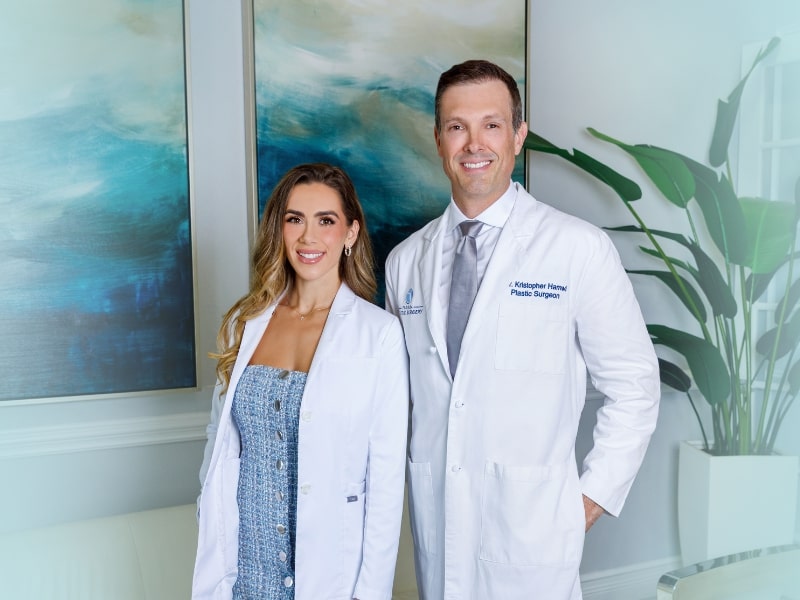
Dr. Kristopher Hamwi has trained for over ten years at some of the world’s top institutions to become one of Florida’s best aesthetic plastic surgeons. Utilizing his exceptional skill, rigorous training, and genuine, caring approach, Dr. Hamwi strives for total patient satisfaction. Ready to partner with Sarasota’s leading aesthetic plastic surgeon?
Today’s Landscape: Safe, Reliable Augmentation
Put it all together, and the picture is clear: patients now have more, and safer, options than ever. Today’s choices include traditional saline, structured saline, cohesive silicone gel, and highly cohesive gummy bear implants, in round or shaped designs, across a broad range of sizes, profiles, and projections. For patients seeking a more modest change, fat transfer has also emerged as a natural alternative or complement to implants.
Just as important as the devices themselves is the modern emphasis on informed choice, surgical technique, natural-looking results, and long-term follow-up. The conversation and trust between surgeon and patient have become a central part of the process, not an afterthought.
Choosing What’s Right for You: Find Personalized Breast Augmentation in Sarasota, FL
There is no single “best” implant, only the implant that best fits your body, your tissue, your goals, and your lifestyle most appropriately. The right choice depends on factors that are difficult to judge from photos or forums alone, which is exactly why a consultation with a board-certified plastic surgeon like Dr. Hamwi is so valuable.
If you are thinking about breast augmentation in Sarasota, FL, Dr. Hamwi will walk you through the full range of modern options and help you understand what is best for you, your body, and your lifestyle. To learn more about what breast implant options are available for you, you can call our office at (941) 800-2000 or schedule a surgical consultation online and take the next step with confidence.
